
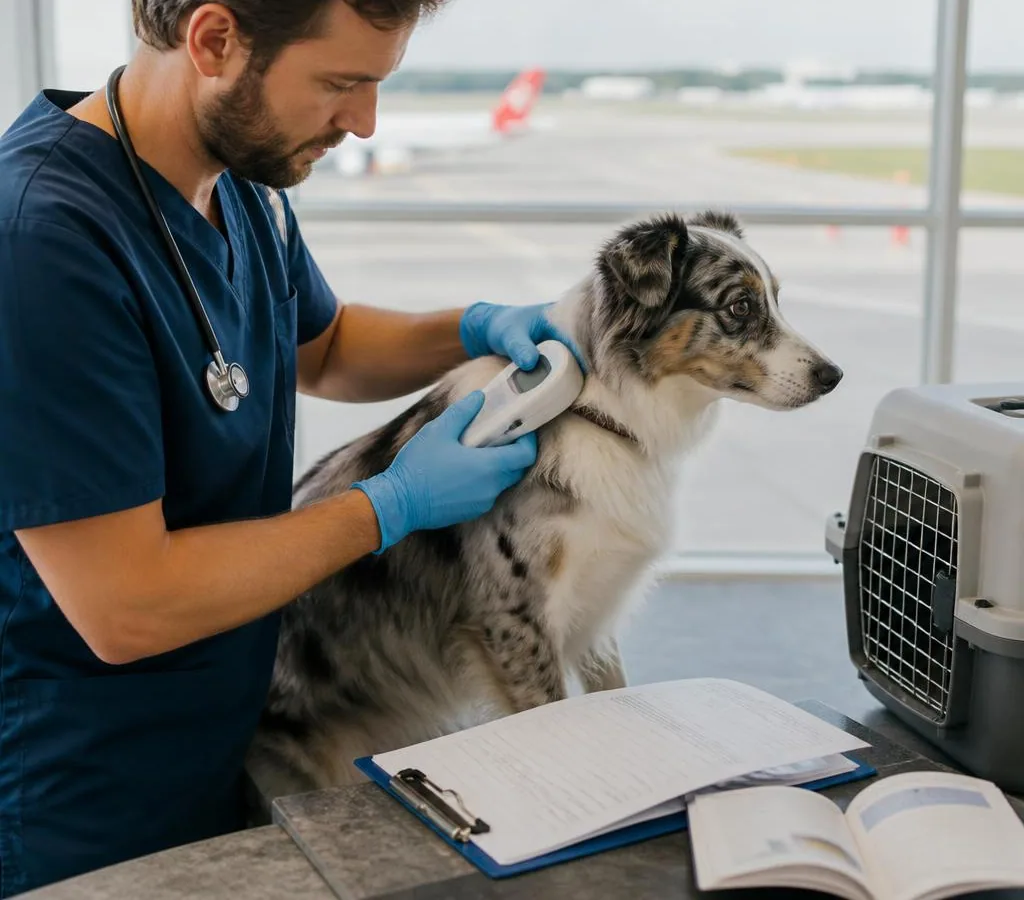
A USA to UK pet journey via continental Europe normally involves two entries and two sets of rules. The dog or cat first enters the European Union at the airport where the transatlantic flight lands. It later enters Great Britain through an approved Channel route.
The safest approach is to show a USDA-accredited veterinarian the complete itinerary before any certificate is prepared. Do not ask only for paperwork to board the flight or enter the first country.
Published and reviewed 19 October 2026. This guide covers non-commercial travel with dogs, cats and ferrets. Rules can change, and different rules apply to commercial movements, ownership transfers, rescue or rehoming journeys, unaccompanied animals and larger groups.
The short answer
For a typical owner-accompanied journey from the USA to an EU airport and then to Great Britain, prepare for:
- an ISO-compatible microchip or a compatible reader;
- valid rabies vaccination evidence linked to that microchip;
- the applicable waiting period after a primary rabies vaccination;
- an EU animal health certificate for entry from the United States;
- USDA endorsement and the non-commercial declaration for the EU certificate;
- a travel document accepted by Great Britain for the later UK entry;
- dog tapeworm treatment recorded within the UK entry window, unless exempt;
- original records and written owner authorisation where another person travels with the pet.
The EU and Great Britain documents are not interchangeable names for one form. Depending on the itinerary, a traveller may need an EU certificate for the first border and a Great Britain pet health certificate for the second.
Document map for the two-border route
| Stage | Authority to check | Typical document purpose |
|---|---|---|
| USA departure | USDA APHIS and the airline | Certificate issuance, official endorsement and carrier acceptance |
| First EU airport | European Commission and the arrival-country authority | Entry of the pet from a non-EU country |
| Calais to Folkestone | GOV.UK and the approved carrier | Entry of the pet into Great Britain |
| Private road transfer | EuroPaw Travel | Passenger, pet, carrier, luggage and route planning |
EuroPaw can plan the road section, but it cannot issue, endorse or guarantee acceptance of veterinary documents.
Step 1: identify the pet correctly
The pet should have a microchip compatible with the scanners used for EU and Great Britain entry. EU guidance refers to the technical standard for pet identification. If a chip is not compatible with the standard reader, the traveller may need to provide a suitable reader.
The identification must come before, or be read and recorded before, the rabies vaccination used for travel. Ask the veterinarian to scan the chip at the preparation appointment and compare the number character by character across every form.
A single transposed digit can cause a serious problem even when the correct animal is standing at the border.
Step 2: check rabies vaccination history
The rabies vaccination must be valid and linked to the microchip. After a first or primary rabies vaccination, at least 21 full days normally have to pass before travel. The rules for a booster depend on continuous valid coverage and the information recorded in the certificate.
Do not rely on a vaccine reminder email. Take the complete rabies records to the USDA-accredited veterinarian. If there was a lapse, if the chip was fitted after the vaccination or if earlier certificates do not show the chip number, the travel date may need to change.
For a qualifying direct journey from the United States to the EU, a rabies antibody titration test is not normally required because the USA is included in the relevant listed-country arrangements. Transit through another country can affect the position, so the veterinarian should review the full flight route.
Step 3: obtain the EU animal health certificate
A pet travelling from the United States into the EU normally needs the current EU animal health certificate for the species and movement type. A USDA-accredited veterinarian completes the certificate and submits it for USDA endorsement through the official process.
The non-commercial certificate is for a private movement where the pet is not being sold or transferred and the owner, or an authorised person, travels under the permitted timing conditions. The signed non-commercial declaration must accompany it.
USDA states that the official endorsement must fall within the applicable period before the pet arrives in the EU. Keep the printed endorsed certificate with the animal. Use the country page for the actual first arrival point:
The EU certificate can support onward movement within the EU during its official validity, provided the rabies vaccination remains valid. Great Britain is not an EU Member State, so do not treat that onward validity as automatic permission to enter Great Britain.
Step 4: complete EU arrival checks
The pet normally enters through a designated travellers' point of entry where the competent authority checks the documents and identity. Follow the arrival-country instructions and the airline's release process.
For Paris, use the French Customs guidance. For Amsterdam, use the Netherlands Food and Consumer Product Safety Authority guidance. For Brussels, use the Belgian official pet-travel guidance.
Do not leave the airport with the animal until every required entry step is complete.
Step 5: prepare the accepted Great Britain document
GOV.UK publishes the documents accepted for entry into England, Scotland and Wales. A pet coming from the USA can travel with a Great Britain pet health certificate when the certificate and the rest of the entry conditions are valid.
A Great Britain pet health certificate must be completed, signed, stamped and dated through the authorised official process. GOV.UK states that the pet must enter Great Britain within 10 days of the certificate being issued. USDA publishes the current US process and certificate choices for journeys to Great Britain.
For a route that first lands in the EU, ask the USDA-accredited veterinarian to confirm how both certificates should be prepared and how each time window applies. The sources to use are:
- USDA APHIS United Kingdom and Great Britain destination page
- GOV.UK accepted pet travel documents
- GOV.UK Great Britain pet health certificate guidance
An EU animal health certificate issued in the United States is not the same thing as an EU pet passport, an Animal Health Certificate issued in Great Britain or a Great Britain pet health certificate.
Step 6: arrange dog tapeworm treatment
Most dogs entering Great Britain from continental Europe need treatment against Echinococcus multilocularis. A veterinarian must administer the treatment no less than 24 hours and no more than 120 hours before the dog enters Great Britain and record the required details correctly.
Plan against the expected time at the UK border, not departure from the USA or arrival at the EU airport. The record should include the medicine information, date, time and veterinary authentication required by the accepted document.
Cats and ferrets do not need this dog-specific treatment. A small set of direct-route exemptions exists, but a journey through France to Great Britain is not normally exempt. Check GOV.UK tapeworm guidance and the EuroPaw timing guide.
Step 7: confirm the route is approved
Great Britain requires pets to use an approved route and carrier unless a stated exemption applies. EuroPaw's published road journey uses Eurotunnel Le Shuttle from Calais Coquelles to Folkestone Cheriton. GOV.UK lists that rail route for pet travel.
Approved-route lists can change. Recheck the current GOV.UK sea and rail list before travel.
When the movement may not be non-commercial
Tell the veterinarian and transport provider if:
- the pet is being sold, rehomed or transferred to a new owner;
- the owner will not travel within the permitted period;
- more than five pets are travelling without an eligible event exemption;
- a rescue, breeder or business is involved;
- the animal travels entirely under an unaccompanied freight arrangement.
Those facts can move the journey into a commercial or additional-rules process. Using a non-commercial form for a commercial movement is not a shortcut.
Original documents to keep together
Carry a waterproof or protective folder containing:
- the printed endorsed EU animal health certificate;
- the signed EU non-commercial declaration;
- the original Great Britain document;
- rabies vaccination certificates;
- microchip evidence;
- dog tapeworm treatment record if required;
- written owner authorisation if applicable;
- airline pet confirmation;
- copies of passenger travel details that support the non-commercial timing;
- EuroPaw booking and contact information.
Photographs or cloud copies are sensible backups, but they should not replace originals required for inspection.
Final check before leaving for the airport
- Scan the microchip and match the number on every certificate.
- Confirm the rabies vaccination is valid for the complete itinerary.
- Check that the first-vaccination waiting period has passed.
- Confirm USDA endorsement and certificate dates against EU arrival.
- Check the Great Britain certificate date against UK entry.
- Verify dog tapeworm treatment against the expected border time.
- Confirm owner names, addresses and pet descriptions are consistent.
- Carry the signed non-commercial and authorisation declarations.
- Reconfirm the pet booking with the airline.
- Reconfirm the approved Channel route and EuroPaw collection details.
If any date, chip number or signature appears wrong, contact the issuing veterinarian before travel.
Frequently asked questions
Do I need two health certificates for USA to UK travel via Europe?
You may need an EU animal health certificate for the first EU entry and a Great Britain pet health certificate or another document accepted by GOV.UK for the later UK entry. Ask a USDA-accredited veterinarian to assess the exact itinerary.
Can a US pet get an EU pet passport on arrival?
Do not base the journey on that assumption. A US-origin pet normally enters with an endorsed EU animal health certificate. An EU pet passport has separate issuing and residency conditions.
Is a rabies blood test required from the USA?
It is not normally required for a qualifying direct movement from the United States to the EU or Great Britain because the USA is listed for this purpose. Transit and individual circumstances can change the analysis.
How early can the certificates be prepared?
Each certificate and endorsement has its own validity window. The EU arrival and the later Great Britain entry dates must both fit. Give the veterinarian the full timetable rather than choosing dates from a generic checklist.
Does a cat need tapeworm treatment?
No. The 24 to 120 hour tapeworm requirement applies to dogs entering Great Britain from most countries, not cats or ferrets.
Can EuroPaw check my documents?
EuroPaw may remind passengers about the commonly checked items, but it does not issue certificates or replace a USDA-accredited veterinarian, USDA APHIS, EU border authority or GOV.UK. The traveller remains responsible for valid documents.
Plan the transport after the document timeline is clear
Read the USA to UK via Europe service page and contact EuroPaw Travel with the arrival airport, flight, UK destination, passenger, pet, carrier and luggage details. We can then plan the private road section around the confirmed itinerary.