
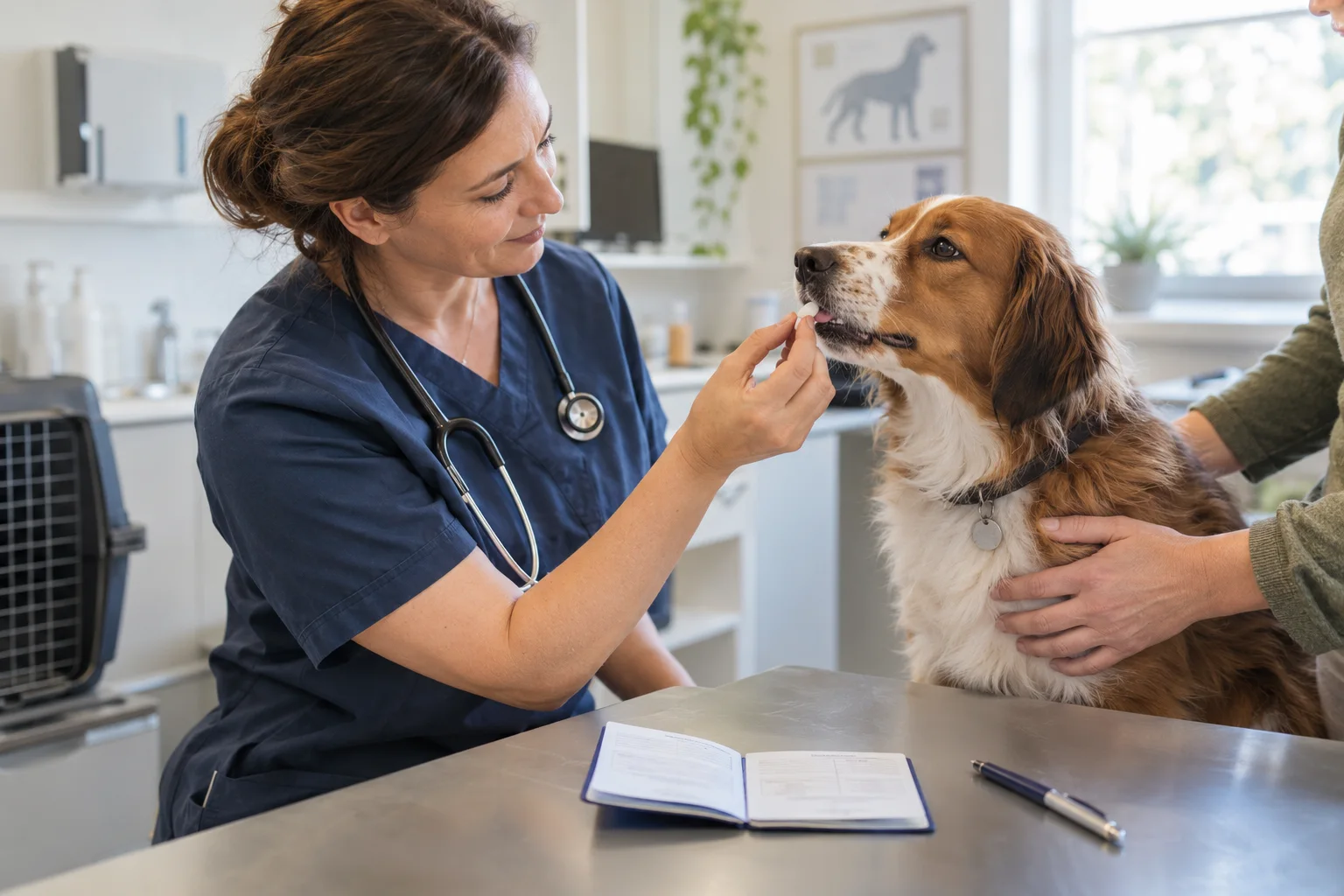
At a glance: for most dogs entering Great Britain, a vet must give tapeworm treatment no less than 24 hours and no more than 120 hours (five days) before the dog’s expected arrival. The rule applies to dogs entering England, Scotland and Wales. Northern Ireland has separate guidance.
The 24–120 hour window
Count backwards from the expected time your dog enters Great Britain: treatment must be given at least 24 hours before arrival and within the previous 120 hours.
Allow for the expected border arrival time, including likely delays. Departure and check-in times do not set the window.
Who needs tapeworm treatment?
Most dogs travelling into Great Britain need a vet to give tapeworm treatment before each entry. This requirement is for dogs only: this particular tapeworm-treatment rule does not apply to cats.
There is an exemption for dogs arriving directly in Great Britain from Finland, Ireland, Northern Ireland, Malta or Norway. The exemption is about the direct journey into Great Britain; do not assume that every route involving one of these places qualifies. Check the current official guidance for your precise itinerary.
Great Britain means England, Scotland and Wales. Northern Ireland follows separate pet travel guidance, so do not use this article as a substitute for checking the rules that apply there.
How to calculate the 24–120 hour window
Use the expected time your dog enters Great Britain as your reference. For a Channel crossing, plan against the expected arrival on the Great Britain side, not the time you leave Paris, Brussels or Amsterdam and not the time you check in.
Official-style example
If the vet treats your dog at 1pm on Monday, your dog must arrive in Great Britain after 1pm on Tuesday and no later than 1pm on Saturday.
The lower boundary is strict: arrival must be after the 24-hour point. The upper boundary is 120 hours. Because the interval is measured in hours, make sure the treatment record and your arrival estimate include the exact time, not just the calendar date.
What treatment and product are required?
A vet must administer the treatment. The product must be approved for use in the country where it is given and contain praziquantel, or an equivalent proven effective against Echinococcus multilocularis.
Ask your vet to confirm that the product and timing are suitable for your dog and your planned journey. This article is general journey guidance, not veterinary advice and not a recommendation for a particular product or dose.
What must your vet record?
Before you leave the appointment, check that the treatment is entered in the Echinococcus treatment section of your dog’s pet passport or health certificate. The record must include:
- the product name and manufacturer;
- the exact date and time the treatment was given; and
- the vet’s stamp and signature.
A medication receipt or a note elsewhere in the paperwork is not a substitute for checking the required treatment section. Keep the travel document accessible for the carrier’s pet checks.
The vet does not have to be an Official Veterinarian solely to administer this treatment. Other travel documents can have their own rules, so ask your vet about the full paperwork for your journey.
What if your journey is delayed or the window expires?
Contact your vet and carrier as soon as your expected arrival time changes. If the dog will arrive more than 120 hours after treatment, a new treatment may be needed before entering Great Britain. Do not assume the original record will remain valid just because the treatment was correctly timed when you first planned to travel.
Non-compliance can mean your dog is refused entry or placed in quarantine. The owner is responsible for the resulting costs. Confirm what to do with your vet and carrier before travelling; they can advise on the practical next steps for your route.
Short return trips of five days or less
If you are taking your dog out of Great Britain and returning within five days, GOV.UK says you can arrange the treatment with a vet before you leave. Your dog must re-enter Great Britain after 24 hours have passed and within 120 hours of the treatment.
This is a narrow timing arrangement, not a general exemption. If the trip changes or you are unsure whether the return will fit the window, speak to your vet before departure. Check the official guidance for the exact circumstances, including very short trips.
Common timing mistakes to avoid
- Counting from departure: calculate from expected arrival in Great Britain.
- Using check-in time: check-in is not the arrival point that defines the treatment window.
- Recording only a date: the vet must record the exact time as well.
- Leaving without the stamp or signature: check both are present in the Echinococcus treatment section.
- Using an optimistic arrival estimate: allow for traffic, queues and crossing disruption when planning the appointment.
- Assuming every route from an exempt country qualifies: the exemption is for direct arrivals from the listed places.
- Applying the dog rule to a cat: this particular treatment requirement is for dogs, not cats.
Planning a France, Belgium or Netherlands to UK journey
For a journey from France, Belgium or the Netherlands, ask your vet to schedule the appointment against the expected time your dog will enter Great Britain. A Paris, Brussels or Amsterdam departure time is not the start of the official window. Include the likely road journey, check-in, crossing and border processing when estimating arrival.
If plans change, recalculate the arrival window before travelling and contact your vet and carrier if the treatment could fall outside it. Keep your dog’s travel document available for the required checks. Our Eurotunnel pet travel guide explains the crossing process, while the main UK pet travel requirements guide covers the wider document rules.
You can also read about dog transport from France to the UK, review our route information, or contact EuroPaw Travel about a journey.
Official sources
- GOV.UK: Tapeworm treatment for dogs travelling to Great Britain
- GOV.UK: Bring your pet to Great Britain
- GOV.UK: Pet travel checks by transport carriers
Information checked against GOV.UK guidance on 13 October 2026.
EuroPaw Travel provides general journey guidance only. We cannot check, approve or validate veterinary documents. The owner must confirm the requirements with their vet and GOV.UK.
Frequently asked questions
Does a vet have to administer the tapeworm treatment?
Yes. A vet must give the treatment and record it in the Echinococcus treatment section of the pet passport or health certificate.
Does the vet need to be an Official Veterinarian?
No. The vet does not have to be an Official Veterinarian solely to give this treatment. Other travel documents may have separate requirements.
Do cats need tapeworm treatment before entering Great Britain?
No. This specific tapeworm-treatment rule applies to dogs. It does not apply to cats.
Is the 24–120 hour window based on departure or arrival?
It is based on the dog's expected arrival time in Great Britain, not the departure time or check-in time.
What should I do if travel is delayed beyond 120 hours?
Contact your vet and carrier promptly. If the dog will arrive more than 120 hours after treatment, a new treatment may be needed before entry to Great Britain.
Which direct routes are exempt from the treatment?
Dogs arriving directly in Great Britain from Finland, Ireland, Northern Ireland, Malta or Norway do not need this treatment.