
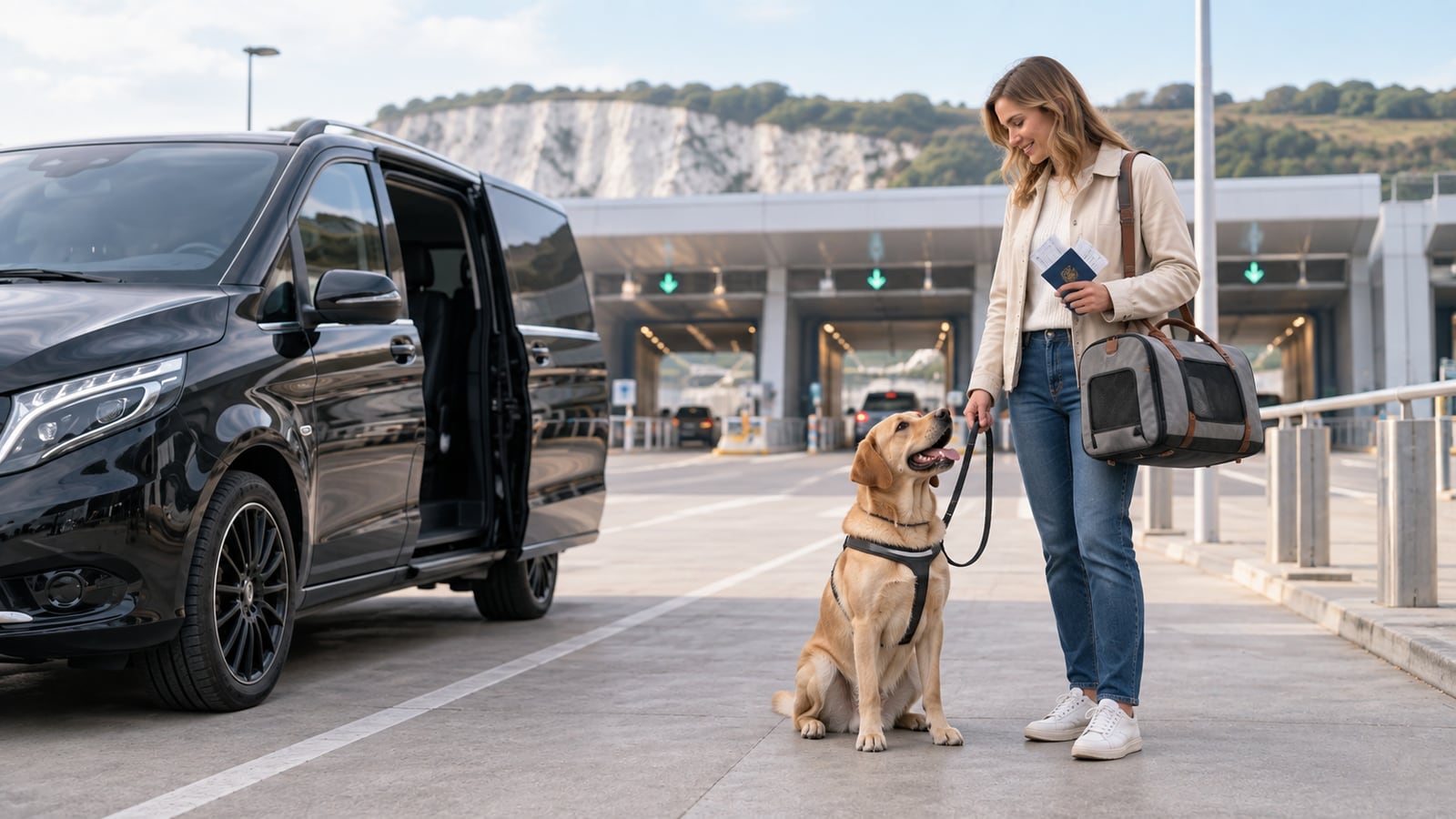
This guide explains the Eurotunnel part of a France to UK pet journey. It is not a duplicate of our route pages. For route-specific bookings, use pages such as Calais to UK pet taxi, Paris to Folkestone pet taxi or Paris to London pet taxi.
Important: pet owners are responsible for making sure all UK entry documents are valid before travelling. Always confirm requirements with your vet before the journey.
Why Eurotunnel works well for dogs and cats
The main benefit of Eurotunnel is that pets are not separated from their owner during the crossing. The vehicle drives onto the train, remains stationary during the journey, then drives off at Folkestone on the UK side.
For many pets, this is calmer than changing between taxis, trains, ferries or airport cargo processes. The environment is more controlled, the crossing is short, and the pet can remain in a familiar vehicle with the owner nearby.
How the Eurotunnel crossing process usually works
A France to UK pet taxi journey using Eurotunnel usually follows a simple route: travel to the terminal near Calais, complete the necessary checks, board Le Shuttle, cross to Folkestone, then continue by road to the UK destination.
1. Travel to Coquelles
The vehicle travels to the Eurotunnel terminal near Calais. For Paris, CDG, Orly or Lille pickups, this is part of the private transfer route.
2. Pet travel checks
Before UK entry, pet documents may be checked. Dogs and cats should have the correct paperwork prepared before arriving at the terminal.
3. Board Le Shuttle
The vehicle drives onto the train. You and your pet remain with the vehicle during the crossing.
4. Arrive in Folkestone
After the crossing, the vehicle drives off at Folkestone and continues to the UK destination.
What happens to the pet during the crossing?
Dogs and cats normally remain inside the vehicle during the Eurotunnel crossing. The crossing itself is short, but the full terminal process takes longer because of check-in, waiting, boarding and arrival procedures.
Owners should bring water, a lead, any carrier or crate used by the pet, and something familiar such as a blanket or travel mat. Nervous pets often cope better when their usual routine and smell are kept as normal as possible.
Eurotunnel compared with ferry travel
Ferry travel can work for some pet owners, but the experience is different. Depending on the ferry operator and route, pets may need to remain in the vehicle or in a designated pet area while passengers move elsewhere on the ship.
Eurotunnel is often preferred for private pet taxi journeys because it keeps the owner, pet and vehicle together. This is especially useful for older pets, anxious dogs, cats, large breeds, rescue pets or animals that do not cope well with busy public transport environments.
Eurotunnel
- Pet stays with owner in the vehicle
- Short crossing between France and the UK
- No airport cargo handling
- Useful for door-to-door private pet transport
Ferry
- Rules vary by ferry operator and route
- Pets may not remain beside the owner throughout
- Crossing and boarding can take longer
- May be less suitable for anxious pets
Documents to check before arriving at Eurotunnel
Eurotunnel does not replace UK pet entry rules. Before travelling, owners should check that the pet’s microchip, rabies vaccination record, travel document and any dog tapeworm treatment are correct.
For the full internal guide, use our UK pet travel requirements page. That page is the main document guide on the website, so this article only gives a short overview to avoid duplicate content.
Is the Eurotunnel ticket included in the pet taxi price?
The Eurotunnel ticket is normally charged separately from the private pet taxi fare. This is because crossing prices can vary depending on date, time, vehicle size and availability.
For route pricing, check the pet taxi prices page. For a wider explanation of how France to UK pet taxi costs are calculated, read the France to UK pet taxi cost guide.
Best routes for Eurotunnel pet travel
Eurotunnel is most commonly used for pet taxi journeys that pass through Calais and Folkestone. The shortest route is usually Calais to Folkestone, while Paris, CDG, Orly and Lille pickups add more road travel before the crossing.
After arrival in Folkestone, the vehicle can continue to London, Kent or other UK destinations depending on the booking.
Eurotunnel pet travel FAQs
Can pets stay with their owner on Eurotunnel?
Yes. When travelling by Eurotunnel Le Shuttle, dogs and cats normally stay inside the vehicle with their owner during the crossing between France and the UK.
How long is the Eurotunnel crossing with pets?
The train crossing itself usually takes around 35 minutes between Coquelles, near Calais, and Folkestone. The full journey also includes terminal check-in, pre-boarding pet document checks, loading and onward driving time.
Do dogs or cats travel in cargo on Eurotunnel?
No. Eurotunnel is not an air cargo service. Pets remain in the vehicle with the passenger during the crossing.
Is the Eurotunnel ticket included in the pet taxi fare?
Normally, no. The private pet taxi fare and the Eurotunnel ticket are priced separately unless confirmed otherwise before booking.
Why do many pet owners prefer Eurotunnel instead of a ferry?
Many owners prefer Eurotunnel because the crossing is short and pets can remain with them in the vehicle. Ferry rules vary by operator and may involve pets staying in the vehicle on the car deck.
Related pet taxi pages
These pages support route, pricing and document intent without making this article compete directly with the main service pages.